

Title: ‘What does this mean?’ – The use of abbreviations in clinical records
Abstract:
Background: Record keeping is an essential aspect of healthcare; abbreviations are often used within records to aid ease of understanding, and to allow for a more streamlined and concise notes. However, with a multitude of abbreviations within dentistry it is vital only approved abbreviations are used within records. This is for several reasons:
1. Certain abbreviations can have several meanings, for instance, RCT can mean Root canal treatment or randomised controlled trial –
2. Within the Community Dental Services, patients are seen by several clinicians.
3. Legally, there is an obligation to provide a list of approved abbreviations if an individual/firm makes a subject to access request.
The use of unapproved abbreviations can increase clinical risk if there is confusion regarding its meaning, and can therefore increase clinical risk and so reduce patient safety.
Objectives: To assess the use of abbreviations within clinical notes in the Paediatric Community Dental Service, and determine compliance with the most current guidance, 2017 local guidelines – there is currently no relevant national guidance. To identify commonly-used abbreviations not currently existing on the approved list
Method: Using the patient note software R4, we conducted a retrospective case note review of all patients seen within the service between the 19th-23rd May 2025 . 134 records were identified, and every abbreviation was noted. The Microsoft excel spreadsheet below was used to record the results.

Results: Overall 5427 abbreviations were identified within the patient notes. 59% of these were approved. New patient assessments had the highest number of abbreviations used at 1908, 59% of which were from the approved list.
Graph 1 shows abbreviation use amongst different clinicians –
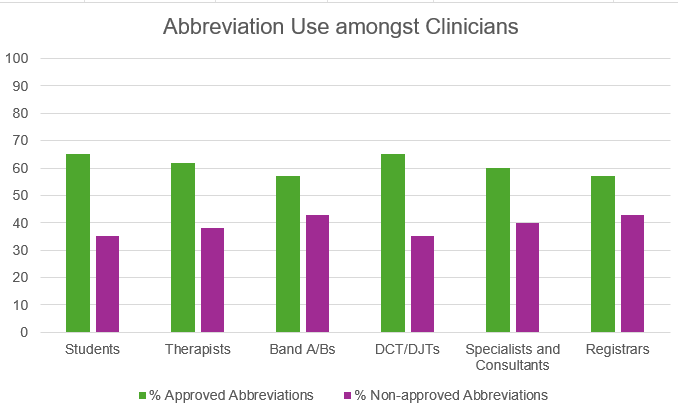
Conclusion: Approved abbreviation use is below the desired standard of 90%. Awareness of the approved list is low, however there is consistency between clinicians. Most abbreviations used were easy to understand. We recommended the service would benefit from a 2025 review, to be updated in line with newer terminology. The findings were disseminated to the paediatric team at the departmental audit meeting, and via email. 2025 updated guidance was also created with input from clinicians.
Cycle 2: Following the implementation of the above recommendations, a second cycle was carried out using the same methodology but with the new Paediatric Community Dental Service List of approved abbreviations/Acronyms 2025 as a reference. 6054 abbreviations were identified between 8th – 12th December 2025.
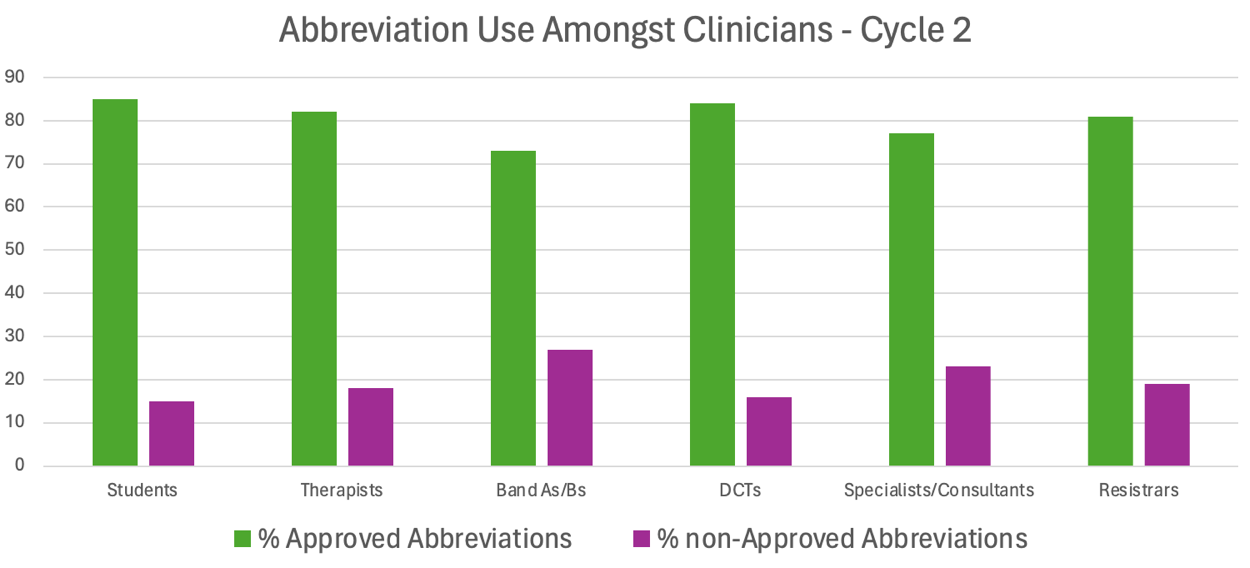
Overall compliance had increased by 18% between cycles 1 and 2, and general awareness of the list appears to have improved. There was general consistency between clinicians (see graph 2) where approved abbreviations were between 73% and 85% of all used – this is significantly higher than cycle 1 for all types of clinicians. However, the overall the results do still show the service is performing below the standard of 90% with 77% of all abbreviations used being from the approved list. Continued awareness of this guidance, as well as potential introduction of inter-specialty trust-wide guidance is being considered. This would improve compliance and allow for greater standardised and streamlined practice.

